
Coaching The World
Five Fs, Benchmark Sets, Faris Al-Sultan, A-Fib

Years ago, Jeff “Doc J” Shilt recommended I coach the world. Jeff’s advice pre-dates YouTube, phones and our ability to stream-to-the-world from our desktop. I have been building the pieces for 20 years.1
Video
YouTube => getting reps speaking2 about topics I know as well as anyone in the world.
Important to remember, we are not necessarily seeking to be successful at YouTube. What we are doing is creating a library of easily shared information. While we build, we create a skill of concise explanation. Then the world offers us feedback on what resonates.
Writing
Endurance Essentials Trilogy => a three-book series: From Lemon To Legend, How To Train and a textbook related to the first & second books.
Book One: Layout the framework.
Book Two: Show how I apply the framework.
Book Three: Explain how to teach and apply the framework for others.
Your books give something tangible to share with influencers, friends and the people who support you. It makes you real.
Audio
Podcasts => Similar to YouTube, conversations are reps interacting with people and getting our thinking straight. You will find, the more interviews you do, the better you get. 20 years ago, I could barely talk on the telephone. Now I can riff for 2 hours without notes.
So far, Bek and I have done six athlete-coach calls. They are a favorite part of my week. Bek has offered to record our calls and make them available to you. I’ve been treating the calls like a graduate seminar on endurance sport. We talk a bit about Bek’s training then we tackle a fundamental topic.
Last week was energy pathways (series coming this winter on Endurance Essentials).
The week before was force-endurance-skill as it relates directly to Bek’s workouts.
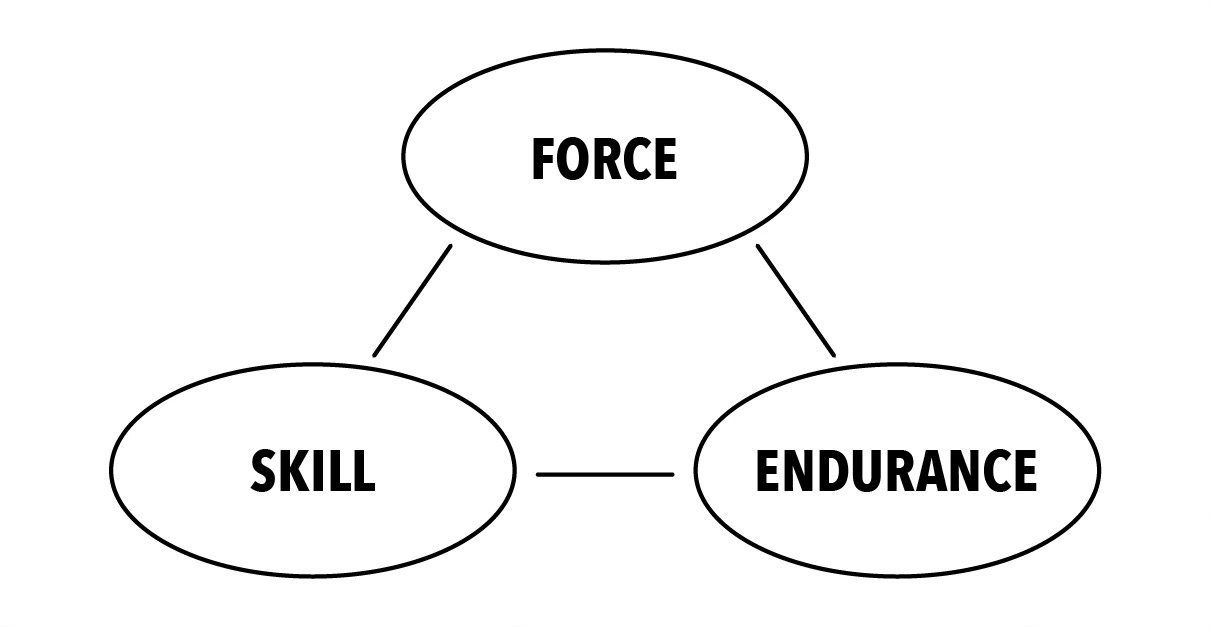
The seminars give me freedom to go deeper and relate the material directly to what Bek’s doing. If you have a topic you want to get covered then follow Bek and engage in his comments.
Resource: My Building A Side Gig series.
Remember The Fs
Fitness is a Function of Flux, Frequency and Fueling.
Flux => use duration to improve efficiency.
Frequency => train more often to improve economy.
Fueling => fuel appropriately to adapt.
We’re going deep on this concept and I have three athletes we will use to explore the concepts.
Henry Huffer, 80 kg, relatively new athlete
Metabolic Marco, 74 kg, top amateur / elite male
Ariana Arrow, 60 kg, top amateur / elite female.
Until you are at the top of your category, focus on the Fs and ignore everything else, Repeat The Week.
Three Podcasts Relevant To What Follows
Mikael (TTS) produces a transcript which I appreciate as I can read faster than I can listen.
Heat Prep
Ross (Real Science Pod) is training for a hot race in South Africa.
You need more Flux, not more Stress.
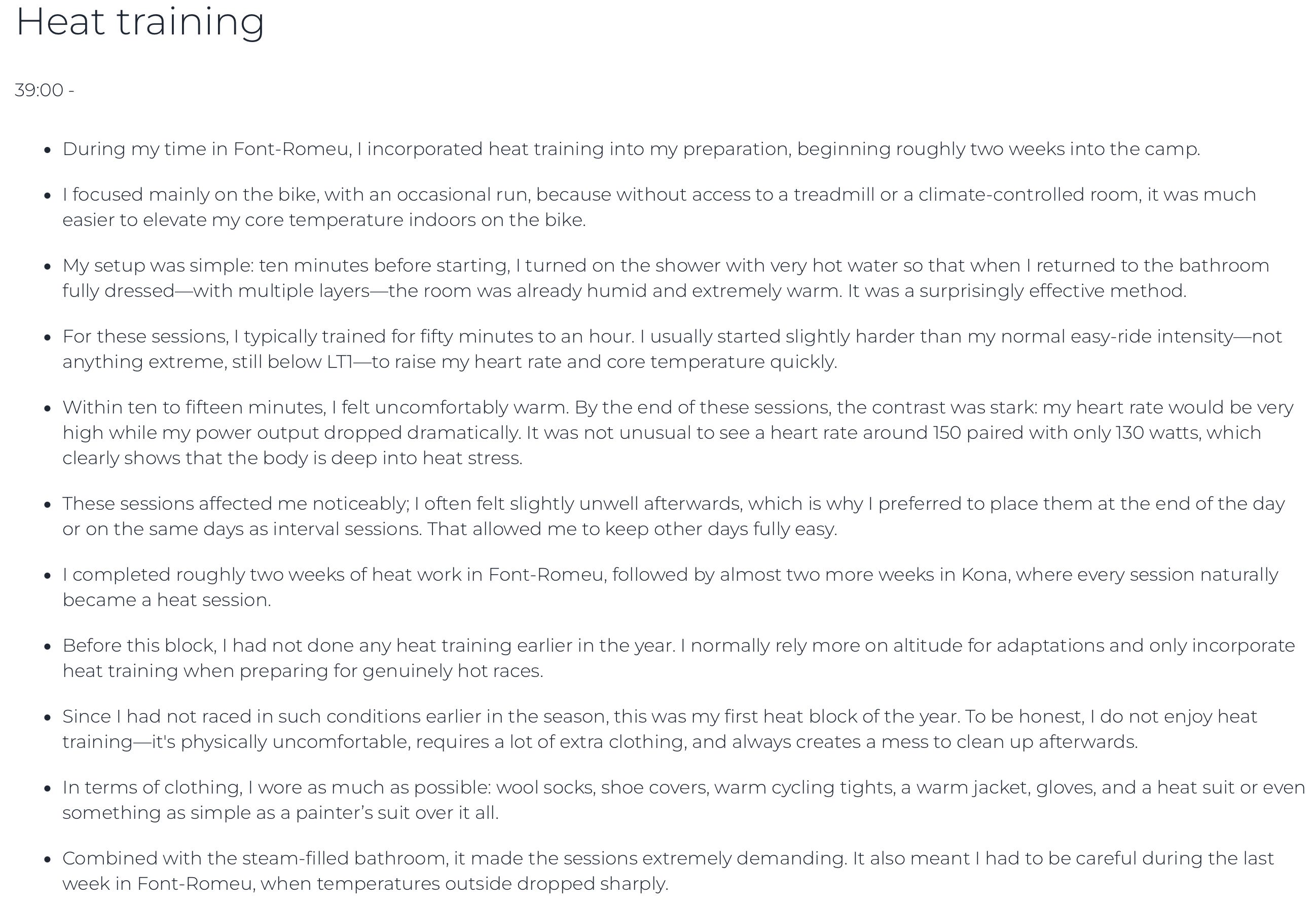
Do not sacrifice (bike) volume for heat stress.
Start your long rides early and continue them into the heat of the day. 60-90 minutes of high heat at the end of the ride will give you what you need.
I do not recommend the low-power, high-stress heat prep sessions for amateurs, even fast ones. The fatigue generated these is equivalent to a moderately-long endurance ride. It is better to ride longer, than hotter.
I make my case in my heat seminar.
Group Training Can Ruin Your Week
…unless you are the fittest person in the group.3
Listen carefully to the Faris interview as he describes how he trained. His partners were amateurs, not the fastest pros. This gets him out the door, keeps it fun but avoids having partners who can ruin his week.
He had a dry, hot, favorite location where he did a ton of base miles. His training was structured as camps to/from his home base in Germany. While I can’t do as many camps as an elite, I take the same approach with camps in Moab/Tucson.
He made the point that ~950 annual hours (18 hours per week avg) is what’s required to be decent.
When PhDs Agree With Practitioners
The guys at the Real Science of Sport pod are catching up to what elite males have known for a long time. If you want to go fast then you need to train carb uptake and tolerance.
What’s interesting is the science showing that economy improves with high rates of carb fueling. The benefit isn’t about maintaining blood glucose levels (a favorite point of the 10g per hour low-carb crew) and an indication that CGMs (continuous glucose monitors) aren’t doing much for anyone other than diabetics.
What’s also interesting is Ross’ point that high carb is beneficial for performance at all speed levels (ie mid-pack amateurs benefit). It’s not just an elite technique.
There also seems to be a mind-body connection with reduced perception of fatigue.
Personally, I don’t concern myself with the mechanism.
The signal is smart scientists agreeing with practitioners and real-world methods. Whenever you see that happening… investigate and experiment in your training.
Fat Gain
If you go high-carb all the time then you’ll gain fat.
I can gain fat training 25 hours a week when I crank my sugar intake. I explain an alternative approach in my book (From Lemon to Legend) and the article linked below.

Atrial Fibrillation
Brief follow up on Athlete’s Heart from two weeks ago.
If you knew what my buddies did to give themselves AFib then you’d sleep easier about the Athlete’s Heart. The formula you want to avoid is chronic strain with chronic energy deficits.
The approach I recommend is far less stressful than intensity-based protocols recommended by others, many of whom I respect.
Hanson Marathon Simulator
From Hansons Run — their Marathon Simulator. Done (for elites) as part of a big week, with zero taper.
4-mile warm up.
Half Marathon Race
10 miles at marathon pace.
Let it rip for final 5 km
4-mile cool down.
That’s a 21-mile day.
How I’d change for a top amateur or elite triathlete. These athletes don’t want, or need, the marathon race and associated recovery.
So you:
Train For The Marathon
Freshen
Do The Marathon Simulator as a C-Priority Race
That would be an excellent way to lift your running across the winter and you don’t disrupt your training by racing a marathon. I hope to demonstrate to you in Winter 2026/27.
I am thinking about doing 2/2 training => two weeks run-focused alternating with two weeks balanced triathlon training. The challenge is to move the needle with my run fitness, without ending up rehabbing another injury.
Solveig Ironman Simulator
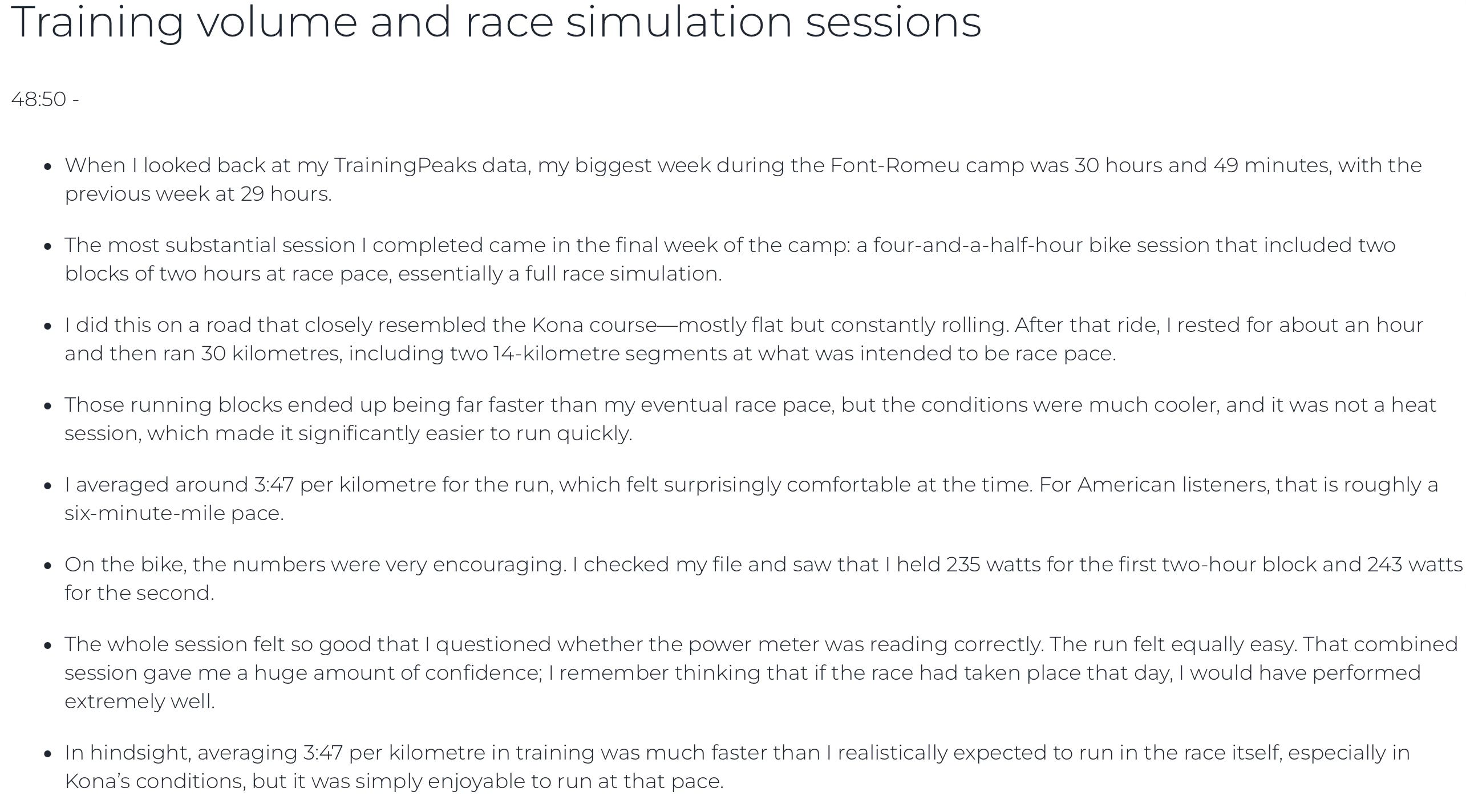
Solveig had an interesting Ironman Simulation Day.
Bike 4.5 hours insert 2x 2 hours at IM effort.
Rest One Hour
Run 30 km insert 2x 14 km at Core Pace
Course was rolling so she was likely moving across Zone 1/2/3 the entire ride. This summer, I used shorter segments (see article below) and rolled up ~3.75 hours worth of work.
As an elite, I would do Solveig’s run session as 3x 8 km at the Boulder Reservoir (4 loops). My fastest season saw me complete three of these and I would be through 20 miles at 2:0x. I went on to run 2:46 at Ironman Canada that year. Averaging 3:47 K pace for her segments is smoking. When I did these runs, I would cap my HR at 152 bpm (10bpm below where I ran a 70.3). This effort is what Americans call Tempo and Nordics call Threshold. It’s a little slower than standalone a marathon pace.4
Big Picture: know your “session” in advance, make your “session” specific to the demands of your A-race. I have a suggestion for your “session” in the video below and prepared a specific preparation template in my Guide to Going Long.
I didn’t do myself any favors when I completely exited competitive sport (2013). Another lesson from Jeff is part time is better than retirement. Meaning, if you have a skill (or field) where you are world-class then don’t exit completely. Figure out a way to reduce, rather than eliminate, involvement.
Feel like chucking it all in? See my article on Getting Past OK to help you understand what’s driving a desire to exit.
YouTube is forced reps in my weakest area. One short video a week is a hurdle I know I can make. Once a week is enough to see significant improvement over 1,000 days.
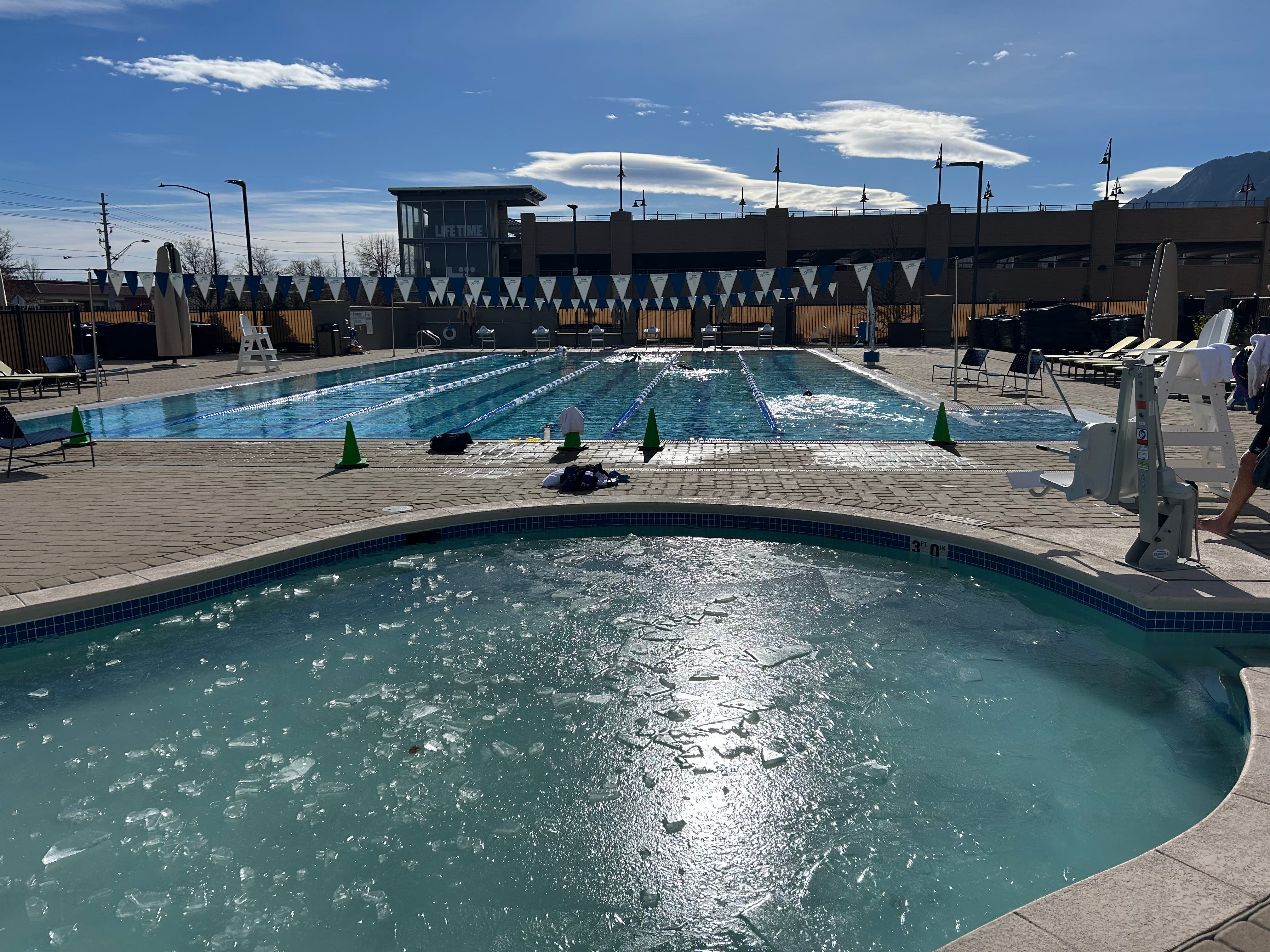
Another tactic I use is wearing a sleeveless wetsuit with my group swims. I get a heat training benefit and my relative intensity is 5-15% lower across the session.
When I do these sessions again I plan on using my treadmill so I can track lactate as well as heart rate. I’d want my lactate to be <=3.0 mmol, ideally closer to 2.5 mmol. It will be interesting to see how they turn out. A sub-3 marathon in an Ironman race requires a Core Pace of ~4:10 per km (6:42 per mile), the closer that pace is to LT1 speed, the easier it is to pull off when fatigued. This target implies LT1 pace close to 4:21 per km (7 minutes per mile). Right now, my easy pace is ~5 minutes per km (~8 minutes per mile).
i love the substack writings that cover multiple topics, thanks for sharing your knowledge
What do you think of Marco Altini's work on fat oxidation? Seems like you can get the best of both worlds by eating fairly (not fully) low-carb and then carb loading and fueling carbs during the actual event.
One of my goals in 2026 is to not use sports nutrition except for during key races. I should be able to fuel without it for almost every workout.